
In a traditional classroom, a child’s success is often reduced to a percentage at the top of a test paper. But walk into a Montessori classroom, and you won’t see report cards or charts with gold stars.
This often leads parents to wonder: How does a Montessori Guide actually measure academic success? If they aren’t grading papers, how do they know a child is actually learning?
The answer lies in shifting the focus from what a child can memorize for a Friday test to how a child learns and how they use the knowledge they’ve acquired.
Here is how Montessori Guides measure true academic and personal success.
1. Continuous, Scientific Observation
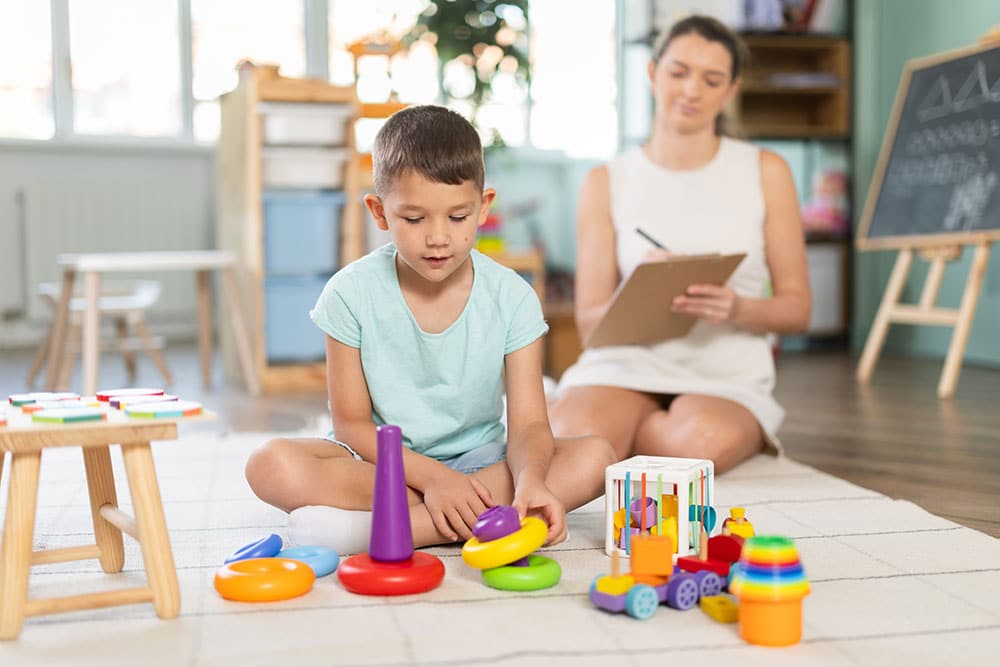
The primary tool of any Montessori Teacher/Guide is observation. They do not sit behind a desk or stand in front of rows of desks; they move through a room filled with students working on the subjects they choose. They take detailed notes on each child’s choices and behaviors.
They are looking for deep engagement: Is the child repeating an activity to master it? How do they handle a mistake? Are they able to concentrate deeply without being distracted?
These daily observations provide a much more accurate, three-dimensional picture of a child’s academic progress than a standardized test ever could.
2. The Three-Period Lesson
To assess whether a child has actually mastered a concept, the Montessori Method uses a foundational technique called the Three-Period Lesson.
- Period 1: Introduction. “This is a unit bead. This is a thousand cube.”
- Period 2: Association. “Show me the thousand cube. Put the unit bead in my hand.” (This is where the child spends the most time, building muscle memory and familiarity.)
- Period 3: Recall. “What is this?”
If a child can confidently name and explain the concept in the third period, the Guide knows the student has internalized the knowledge. If they struggle, it is simply a sign that they need more time in the second period. There is no shame, no failing grade—just an invitation to keep practicing.
3. Autonomy and Material Mastery
In a Montessori environment, the learning materials themselves are “self-correcting.” For example, if a child places a cylinder into the wrong hole in a block, they will be left with one cylinder that doesn’t fit at the end.
True success is measured by the child’s ability to recognize their own errors and fix them independently. When a child can self-correct without looking to an adult for validation, they have achieved true mastery. They are not working to please an adult. They are working to satisfy their own curiosity.
4. Application and Teaching Others
You truly understand a concept when you can teach it to someone else. In our multi-age classrooms, older children frequently give lessons or assist younger peers with their work.
When a Montessori teacher sees an older child guiding a classmate through a complex math material or explaining the parts of a leaf, they are witnessing the highest form of academic assessment. It shows total comprehension and models empathy and leadership.
Redefining Success
In the Montessori world, academic success is not a destination reached at the end of a unit. It is a continuous journey.
Success is measured by a child’s expanding vocabulary, their ability to solve complex long division, their confidence in helping others, and their love for reading. But it is also measured by their resilience, their ability to focus, and their lifelong joy of discovery.
By looking beyond the test, Montessori teachers don’t just measure what a child knows today—they cultivate the thinker, the innovator, and the learner they will become tomorrow.